Agricultural Recycling Services
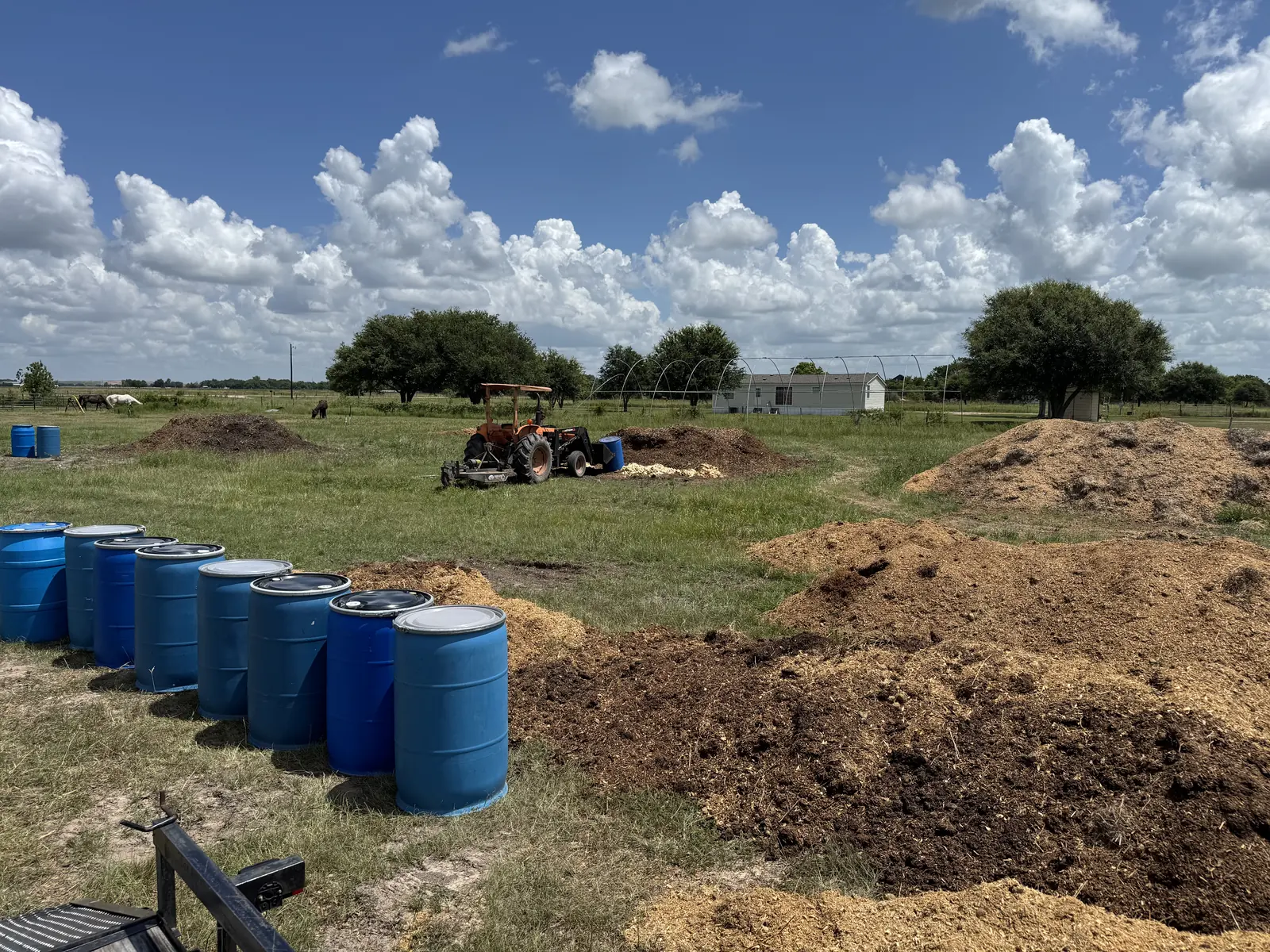
The oldest form of agricultural recycling: food waste back into farm soil. OnFarmCompost collects food scraps from businesses across Harris County and Fort Bend County and Montgomery County, TX and composts them on partner farms. The finished soil stays there.
One loop, two sides
Businesses supply the waste stream. Farms keep the soil.
For businesses with food waste
- 55-gallon gasket-sealed drums, exchanged weekly
- Vegetative food waste: produce culls, trim, and unsold fruit and vegetables
- Weighed at every pickup; monthly diversion report
For farms & landowners
- Host sheet composting on your land. Layered with wood chips and straw.
- The finished compost stays on your farm, feeding your soil
- Builds soil organic matter over seasons, measured against a baseline
Agricultural Recycling FAQ
What agricultural recycling services does OnFarmCompost provide?
Two directions, both ending in farm soil. Vegetative commercial food waste is collected weekly from produce markets, supermarkets, grocers, produce operations, and food producers across Harris County and Fort Bend County and Montgomery County, TX, and composted directly on partner farms. Separately, manure is moved from stables, ranches, and small livestock operations to farms that want it. Material must arrive source-separated or depackaged, never mixed with packaging or trash. The finished compost feeds the farmland it is made on.
Do you handle manure?
Yes, in both directions. Manure is delivered to partner farms as a composting feedstock, and it is collected from stables, ranches, and small livestock operations that have more than they can use. Volume, access, storage, and route fit decide whether a specific load works, so it is quoted per job rather than from a rate card. See the manure composting page for how it composts and which regulatory tier it keeps a site in.
Do you haul crop residue or field waste?
Not as a standing service. Crop residue is usually better handled where it lies, and for most farms the useful answer is composting on site rather than hauling material away and back. If you have a specific stream and a real volume, it is worth a conversation, but do not assume it is a service with a published rate.
How can my farm work with OnFarmCompost?
Farms partner by hosting composting on their land. Delivered food waste and manure are sheet-composted in managed layers on the receiving parcel, and the finished compost stays on that farm. Every arrangement starts with a free site visit, booked by appointment, that settles access, drainage, setbacks, feedstock fit, and regulatory classification before anything is delivered.
What food waste do you accept for agricultural composting?
Produce culls, trim, and overripe or unsold fruit and vegetables; Vegetative food material kept source-separated from packaging; Bulk dry goods such as flour, grain, and expired shelf-stable produce, depackaged; Clean wood chips and untreated woody material; Coffee grounds. Meat, bones, and dairy are all fine, because the on-farm process handles them. Not accepted: meat, bones, fish, and dead animal material; dairy; post-service plate scrapings and any back-of-house food waste; pan grease, fryer grease and oil, including grease-trap waste; paper (towels, napkins, filters); plastics, including "compostable" bioplastics.
What does agricultural food waste recycling cost?
For businesses whose food waste is collected (commercial only, no residential pickup), pricing is $10 per barrel with weekly drum exchange, a free waste audit, and a 1-week free trial. No contract. Manure collection is quoted per job. For farms interested in hosting composting, the site visit is free and terms are settled after it. Call +1 713-822-3398.
Close the loop with us
Food waste in Harris County and Fort Bend County and Montgomery County becomes Texas farm soil.